Thursday Turn Out - 01/15/2026


This week has been a “I solved a problem and, in doing so, created fifteen more” week. Was I able to get an enemy to teleport with Zel? Yes, and all I had to do was:
- add a test enemy to the level;
- graph out where the enemy should go when Zel teleports; and
- edit the four bounding box scripts to reflect those locations.
Lo and behold, the test enemy now teleports with Zel! But does it continue to behave as it should after the jump?
No, not really, and not consistently.
I’m taking a new approach to fixing this problem. With the enemy finite state machine (FSM), I’d fix a bug as soon as I spotted it. I iterated on the FSM code until it finally worked exactly as I needed it to. That was effective, but I don’t know if it’s efficient. What if, instead, I didn’t touch the code until I’d documented as many bugs as possible? And, so far, I’ve found a lot of bugs:
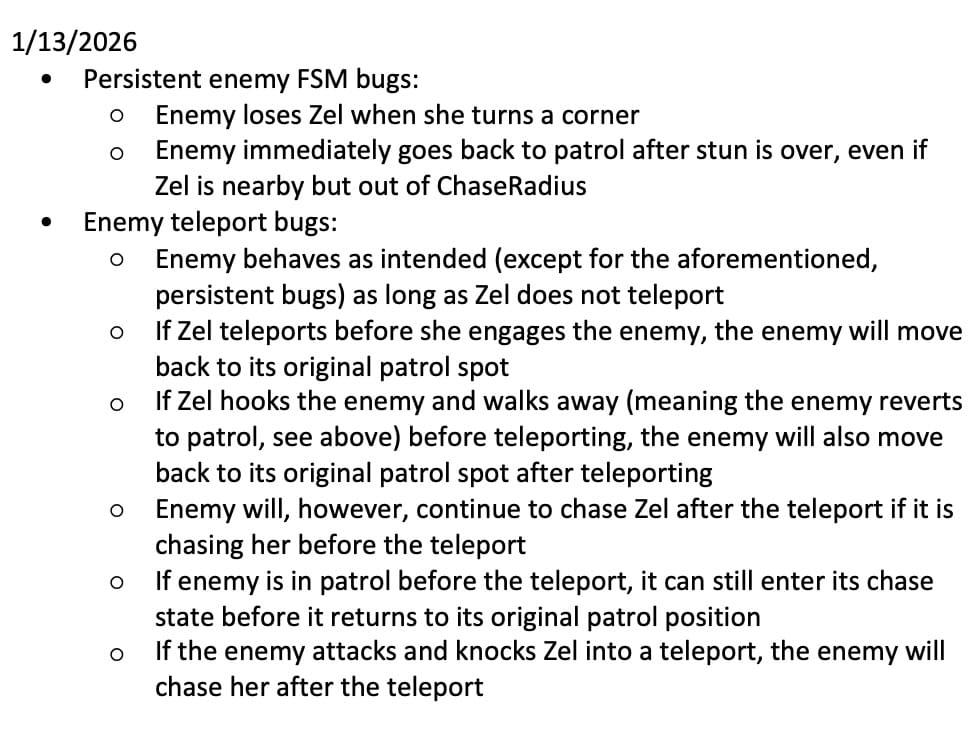
I’m going to spend a few days running the scene and documenting every weird quirk, reloading it and making small changes in how I play the level, in an attempt to suss out every reproducible issue I can. I think discovering multiple bugs, then fixing those bugs, will be a more efficient use of my time. However, I must concede the possibility that trying to fix multiple bugs in succession is a task too insurmountable for my ability as a novice coder.
What progress will I make by Sunday? I suppose you’ll have to find out then, or sign up for the newsletter to have the news sent to you directly!
P.S. No, I haven’t forgotten about completing “Silver and Gossamer,” it’s just that bug-hunting is too fun. Is that weird? It feels weird, but also right.